Sunday, 14 April 2013

Coole Pilate tasting

Andy and I had a first taste of our Cheshire (I mean German) pilsner yesterday. We were very very pleased with the outcome.

If you remember, we had problems last year with our first lager, because we could not carbonate it properly in a keg. So this year we bottled our lager rather than kegging, calling it Coole Pilate (follow the link to find out why). Bottling, we believed, would allow greater carbonation to build up than is possible in a keg (without an explosion!).

So yesterday we tasted it:

Carbonation was excellent. The bottle gave a good hiss when opened, and it pours with fizz, leaving plenty of bubbles in the beer and a light head round the edge.

Colour is a rich golden, with very good clarity (see photo).

The aroma is crisp and hoppy.

The flavour starts with rich maltiness, but then you get hit by considerable bitterness. This is not a British lager; this is a full-on German style pils. It reminds me of the crisp bitterness you get from a Munich Helles.

Coole Pilate Bottle Label

Friday, 12 April 2013

Boiler lagging

We have two boilers in our brewing set up: the first one I bought is an old five gallon Burco that I got on eBay. We now use this purely as a hot liquor tank (hot water to non-brewers!) because I also have a Brupaks beer boiler which is used for actually boiling the beer.

These boilers run for several hours on brew day. The Burco probably runs for 2 hours (on and off) and the Brupaks boiler for a similar time, depending on how long the recipe requires the wort to be boiled for.

That’s quite a bit of electricity, given that the Burco pulls 2.5kW and the Brupaks boiler 2kW.

So on brew day I reckon we must burn about 9 units of electricity, which at 13.5p per unit will cost us about £1.20.

So I popped down to B&Q and bought some reflective radiator insulation – the stuff you slide behind your radiator to bounce the heat back into the room. A pair of scissors, a load of gaffer tape and some sticky Velcro later, we have two lovely jackets for our boilers that come on and off as required. During the boil we are looking to hold as much heat in as possible (this allows us to maintain a better rolling boil too), but as soon as we start chilling the wort we can whip the jacket off to allow faster heat loss.

We made them with two sheets of radiator insulation back to back, which is why they are shiny on both the inside and outside (which is not entirely clear from the photos below).

Oh, one last thing. If you look at the Burco jacket you’ll see that we have cut a small window in it to expose the side of the Burco. Why? So that we can use our infrared thermometer to get an accurate temperature reading from the wall of the vessel!

IMG_2553IMG_2554IMG_2555IMG_2556IMG_2557IMG_2558

Thursday, 11 April 2013

Mauribrew Yeast Trial

In our early brewing days we tried a number of different yeasts, from dried yeast, through liquid yeast (which takes a bit more effort to handle) to yeast cropped from the top of a commercial brewery fermenter. But in recent brews we have settled on one yeast for our English ales which we have found to be reliable and very easy to use: Fermentis Safale S-04.

This is a cracking yeast. It has the necessary flavours for an English ale, it is dead easy to use (simply re-hydrate in some cooled boiled water, then pitch), and we’ve found that we can reliably re-use it by pitching a second (or third) brew onto the yeast cake from the previous batch. Recently I’ve discovered that a number of commercial breweries enjoy this convenience too (although they use 500g packs whilst as a homebrewer I use 11g sachets!).

There is just one down side to it – it’s expensive. An 11g sachet costs about £2.99, which when you consider that ALL the ingredients for a batch cost about £20 is quite a high proportion. I guess because it’s good it’s popular, so they can charge more for it. (Fermentis US-05 is even more expensive, at £3.35 a sachet!).

So on a whim I decided to try another yeast, just to see whether it’s anywhere near as good as S-04. Mauribrew yeast comes from Maurivin, and their Ale 514 yeast is cheaper at £1.99 a sachet.

So on Monday Andy and I brewed gyle 49 – a light bitter hopped with First Gold hops. We’ve called it “Second Gold”, because this is the second time we have used these hops. It’s fermenting right now, and the Mauribrew yeast seems to be working very busily and making good smells in the utility room. I’ll post again when it’s done and we have some feeling for whether the yeast is a success or not.

IMG_2552

Sunday, 31 March 2013

Tollgate Brewery

Last weekend we had a fantastic weekend away with friends at Calke Abbey in South Derbyshire. The National Trust has a property on the estate called Southwood House Farm which is available for rent (sleeps 14). (As an aside this is a lovely property, highly recommended).

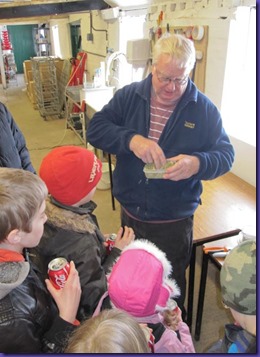
The Trust has been keen to see some of the old farm out-buildings put to use, and recently Tollgate Brewery has relocated from an nearby industrial unit to this more picturesque setting. Brewers Quentin and Pat welcome visitors to the house, and were kind enough to give us a tour of the brewery. In fact, if you remember, last weekend was very snowy – we had at least six inches over the weekend, which pretty much snowed us in. So we were faced with a weekend of snowball fights, good food and of course an unlimited supply of beer! What a hardship!

(One more aside: it was not ME that chose this property. The fact that there was a brewery one site was merely a piece of good luck as far as I was concerned! :-)

Tollgate is a six barrel plant, so pretty similar in size to a lot of UK craft breweries. They have a range of about eight beers which are mainly sold in casks to local pubs, but are also bottled and sold locally, such as in the National Trust shop and at farmers markets. Quentin also has another full time job, so they only brew at the weekend (must be a busy life!).

For a business perspective, I was interested how Quentin and Pat came into brewing. They purchased the brewery relatively recently (in the last couple of years), and at the time neither of them had any experience in brewing. So essentially they wanted to run a business first, and the fact that it is a brewery came second. As a passionate homebrewer this interests me, because obviously I would come to it from the other direction: as a brewer first and businessman second. Having said that, you might argue that brewing skills are easier to learn than business skills, so starting with business skills first might actually result in a better run business.

Anyway, the tour was great – Quentin was very good with the kids, and the beer was excellent too. Can’t think of a better place to have got snowed in!

IMG_6677IMG_2418IMG_2415IMG_6836IMG_6679

Saturday, 16 March 2013

Coole Pilate

Andy and I have been absolutely bombed out with other stuff going on in our lives recently, but we realised this week that we really need to get our pilsner bottled. It was brewed on 10th February, fermented for about three and a half weeks, then I dropped the temperature down to 4C to let it start “lagering”.

But it’s been sat on the yeast cake since then, and I really wanted to get it bottled in case that started to affect the flavour. So that was last night’s job.

After much consideration we came up with the slightly bizarre name of Coole Pilate.

Why? Well firstly it’s a small hamlet near Audlem in Cheshire, near to where Andy’s family come from. Secondly, it’s got the word “cool” in it, and it is a lager after all. Thirdly, it has got the letters “pil” in it, and it is a pils after all. And fourthly, it’s our beer and we can call it what we like. I claim that it is the first beer ever to be graced with that name. So there.

And since you asked Gill, it’s pronounced like Pontius, not like a form of yoga. I think.

Coole Pilate Bottle Label

Friday, 1 March 2013

Beeston Castle fiasco

We’ve been trying to drink up the Beeston Castle porter, which has turned out to be a bit of a problem. I’ve just checked back on previous blogs posts, and it seems that I didn’t write an article about this brew. We made it back in May 2012, with the plan to bottle all of it and lay it down for a few months.

But we’ve had a real problem with carbonation. About a third of the bottles have carbonated nicely and are, frankly, delicious. The remaining two third are totally flat and have a nasty oxidised taste.

So we’ve had to designate it “for brewery consumption only”, because we can’t give any bottles away with a hit rate like that. It just needs drinking up and the bad ones disposing of, which is rather a shame. (Although I have saved a couple of bottles for steak and ale pies! :-)

We’re not exactly sure what the cause of the problem is. My best guess is that it was a faulty batch of crown corks. I would guess that the bad ones have not quite sealed properly, which has lead to no carbonation and a little oxygen getting in. If that’s the case, it’s a hell of a problem, because how to do tell when you are bottling a brew whether the crown corks are OK? I’m going to ditch the remaining corks from that bag just in case, but it does worry me for future brews.

IMG_2183

Monday, 11 February 2013

A train sleeps in a siding

The driver guzzles another can of lager…

The last (and only) time we made lager was last year, a Bohemian Pilsner (in other words a Czech lager like Budvar). Regular readers will remember that it turned out pleasingly malty, but we had some problems making it fizzy.

So this year our lager will be a really simple German Pilsner. 100% lager malt and a couple of German hops (Hersbrucker and Tetnang). Last time’s carbonation problems were down to the fact that we could not get enough pressure in our King Keg to dissolve enough of the CO2. So we have concluded that the only way we can be sure our lager is fizzy (short of investing in a Cornelius keg system as used in pubs) is to bottle it.

So yesterday was the brew day. Making lager is a longer affair than making ales because you need to mash for 90 minutes (rather than 60), boil for 90 minutes (rather than 60) and chill the wort to a lower temperature (we chilled to 15C rather than about 22C). I could ramble on for ages about why all that’s necessary, but I’ll spare you the details. In short, it meant that we needed a full day at it (well, 1.30pm to about 8.30pm). But that did give us time to label the Audlem Smoky (or it would if the printer ink hadn’t run out).

Back to the pilsner: it’s currently in the fridge fermenting. The key difference between a lager and an ale is the fermentation temperature – about 10C rather than 20C. Normally our ales are fermented in the house. But for this out came my temperature controller to ensure the fridge stays at exactly the right temperature.

IMG_0436

Since we’ll have a good batch of yeast from this brew, when it is finished we plan to make a rauchbier – a German smoked lager. We’ll pitch that right onto the yeast cake from this brew, giving it a really good start. More about that in a few weeks…