Tuesday, 11 October 2011
Knutsford Brown Ale
Friday, 23 September 2011
Brewing Dunkelweizen
When we brew an English ale we boil the wort for 60 minutes. This achieves the following:
- It extracts the bittering oils from the hops;
- It sterilises the wort – malt is covered in bacteria so if you didn’t sterilise it the yeast would have a hell of a fight on their hands;
- It develops some of the richer “cooked” flavours - the melanoidins from the Maillard reaction: same as when you cook food (imagine microwaving a steak rather than frying and you’ll get the idea).
And as for weighing out all those malts, well the photo speaks for itself:
Dunkelweizen needs to be fermented a little cooler than an English ale – ideally 17C. So it’s currently in the under stairs cupboard sputtering yeast all over the place!
Thursday, 8 September 2011
Porter
Back in June Andy and I made a porter which we planned to bottle and mature for the winter. We tasted a bottle yesterday to see how it is coming along.
Porter is an interesting beer style, most notable because it was the first beer style to be “designed” (rather than just sort of come about over time). Let me take you back to London in 1722. Back then it was very common for the beer drinking working masses to mix fresh and stale beer – I’m not sure whether this was because it was cheaper or because they preferred the taste. Perhaps the stale beer added a pleasing tart edge to the brew (but you wouldn’t choose to drink it neat).
Anyway, enter George Harwood of Shoreditch Brewery. He came up with the idea of engineering a beer for the London workers that tasted like the mixed beer but saved the publican the time by allowing him to only dispense from one cask. Porter was born, reputedly named after the London porters that drank it. It was a massive hit and very soon was being brewed on an industrial scale.
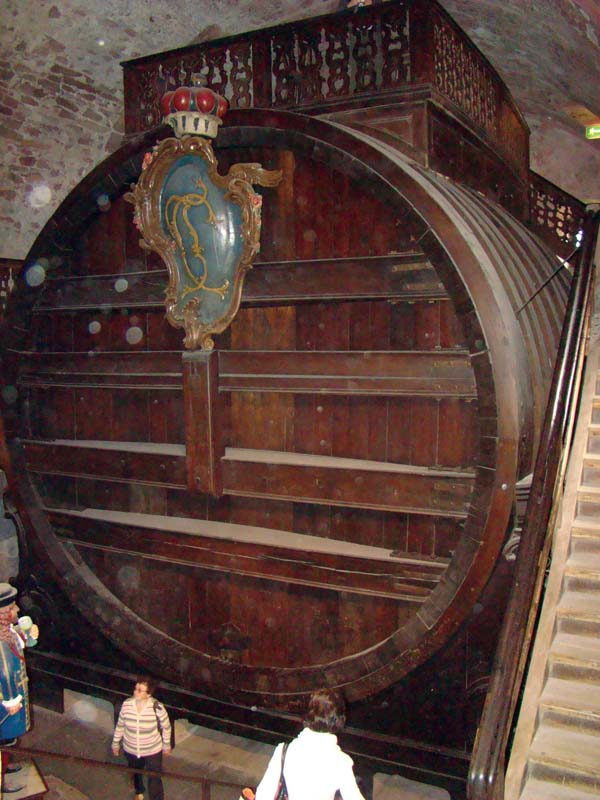
My favourite tale from the story of porter is of the 1814 disaster at Meux. Porter used to be aged in huge vats, some of the largest of which contained approaching a million gallons (yes, really). On 16th October 1814 a 22 foot high vat of porter ruptured. The jet of beer ruptured a further vat and beer flooded the surrounding five block neighbourhood. At least eight people were killed (including women and children) and dozens were injured – crushed by the crowds attempting the consume the fine beer before it soaked into the streets.
Anyway, enough of the history lesson. What’s modern porter like? Well there are actually various different styles of porter: brown porter, robust porter, Baltic porter. We decided to make a London Porter, which I think is in essence a brown porter.
What should it be like? Well obviously colour-wise it is deep deep brown or black, and you’d expect a cream coloured head. It will be fairly strong – 5% – 6% ABV. Taste-wise, you’d expect rich dark malty flavours, giving slightly roasty flavours as well as coffee and chocolate. This is not a session beer, it’s a complex, rich, bold brew with a long lasting aftertaste.
And what was our porter like? Well there’s a bit of a story there, and you’ll just have to wait until the next post, because this one is already long enough! :-)

Friday, 2 September 2011
Red Willow Meet the Brewer
The Fee had a large number of Toby’s beers on: Wreckless, Mirthless, Ageless, Smokeless and Headless. In addition to trying the beers I was able to sit in on Toby’s informal presentation which was fascinating. He was passing round hops, handing out tastings and showing some of the other wacky things he puts in his beers, such as the chipotles (smoked Mexican chillies) that go in Smokeless (smoked porter).
I have to say I am hugely impressed with what Toby is doing – he only started brewing commercially last November and he has already won various awards (such as winning the beer competition at the Mark Addy in Manchester, for which Red Willow will now be the house beer for the next year). Not only does Toby produce top quality regular ales (try Wreckless or Mirthless and you’ll understand what I mean) but he’s also not afraid to try some pretty wild new things such as adding the chipotles, making stout with real oysters and making a Thai beer with no hops – just bittered with Thai spices such as tamarind and lemon grass.
One other thing that I got to try was Ageless (outrageously hoppy 7.2% Double IPA) from both the cask and bottle, side by side. This was fascinating, and not something you’d normally be able to do. Guess what? They were utterly different, like they weren’t the same beer. Not surprisingly the cask was far better – smoother, better aroma and much less gassy.
You can follow his blog here. Seek out his beers, you won’t be disappointed!
Wednesday, 31 August 2011
Munich Malt experiment
But since we've been at this over a year now we decided it was time to branch out, and make our own mistakes. We really wanted to start getting a feel for the characteristics of some of the specific ingredients of beer. Recently we made a couple of ales that were hopped with a single hop: Cascade followed by Nelson Sauvin. These were interesting (although we had a huge issue with clarity of the Nelson and we don't yet know why).
So... to malt. Previously we've just used the "classic" malts used in British Real Ale - pale ale malt (usually maris otter), crystal malt, and a little bit of chocolate and black malt. But there are many other malts out there with their own characteristics, which brought us to munich malt.
Munich malt is used in European beers - both ales and lagers. It's a darker grain than pale ale malt, because it has been kilned for longer. So what we are expecting is a darker, maltier and sweeter beer than a traditional British bitter. We've held right back on the hops as well to keep the bitterness low.
We used two thirds munich malt to one third pale ale malt and a little bit of Kent Golding hops during the boil. (I'd post more on the details of the recipe, but I've tagged this post as "General"!)
At the moment it's busy fermenting, and I'll post details of the results when it's ready to taste.
Tuesday, 30 August 2011
Blog audience
I'd like to write articles about the technicalities of brewing, because at the moment that's what light's my candle. But the reality is that if anybody does read this blog it's more likely to be friends and family (at least initially!), and you are probably not going to care about mash temperatures and BU/GU ratios.
Maybe I'll look at using the "labels" facility. I'll start with:
- General - of general interest to people that know me, and not full of brewing technicalities
- Technical - boring technical brewing stuff that no one will want to read