Sunday, 6 January 2013

Pendle Witches

After the Boddingtons, we decided to move to a stronger slightly darker ale. So at the end of December we brewed a beer based on a recipe for Moorhouses Pendle Witches Brew.

To be honest, I don’t recall what this beer is like, although I think I have had it at some stage in the past. But Graham Wheeler’s recipe book describes it as “a deceptively pale strong bitter”, with a “deep, dry finish, good hop character and vanilla notes”. Sounds nice, so that is what will keep the beer engine busy through February. It has finished fermenting and is ready for going into cask tomorrow.

We’ve developed a process for re-using the yeast from previous brews, by pitching the next brew right onto the yeast cake from the last brew. We reckon we can do that at most three times, and each time we move to a darker and stronger beer than the last one. This is why we started with Boddingtons (very light), then moved to the Pendle Witches brew, and tomorrow we’ll be brewing… well, that’s for another post! By the third brew the number of yeast cells is huge, which means a really strong brew can get off to a good fermentation very quickly.

Incidentally, if you’re into making your own beer and you like British ales, you really should have a copy of Brew Your Own British Real Ale by Graham Wheeler. This is a hugely comprehensive collection of recipes. They all work to basically the same process, so if you can brew one successfully you should be able to do them all.

Image: Amazon.co.uk

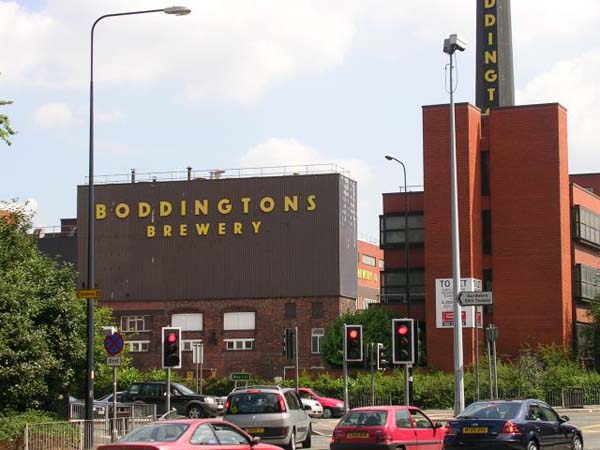
Boddingtons

It’s been another month since my last blog post: Christmas seems to have got in the way of writing blog posts, but you’ll be pleased to hear it’s not got in the way of brewing beer!

So I have quite a bit of catching up to do. To keep them bite-sized, I’ll publish each as a separate post. Here goes with the first.

Our first ever all-grain brew (Gyle* 003, back in June 2010) was based on a Boddingtons recipe. But looking back at what we did, we really didn’t understand at all about how to control the bitterness of a beer. We couldn’t get the required hops (Whitbread Goldings), so for some reason we used 74g of Northern Brewer hops (I think the guy in the brew shops said they were similar – no idea why!). Recalculating it now, that would have made the bitterness about 75 IBU. Somewhat more than the 30 IBU called for by the recipe. :-/

So we re-brewed before Christmas, this time hitting a restrained 27 IBU. The beer has now been kegged and awaits the required (by Andy) maturation period (which seems forever, and I’m THIRSTY!)

By the way, for those who don’t know Boddingtons (is that possible?), it used to be an absolutely classic northern session bitter – beautifully golden in colour, light in body with a rich creamy head, and a lovely almost straw-like aroma. It was brewed at the Strangeways Brewery in Manchester, and was marketed as “The Cream of Manchester”, which indeed it was. You can read about it on Wikipedia here, but in short it got killed by corporate acquisitions. The brewery was closed in 2004. Cask production was moved to Hydes brewery until last year, and now it has been discontinued apart from in pasteurised tins. I learnt my love of real ale from that stuff and I miss it greatly. Sigh.

So in short – we have high hopes that we can make something that is like we all remember Boddingtons from the Strangeways Brewery.

* “Gyle number” is the posh term we brewers use to mean “batch number”.

(Image: http://manchesterhistory.net/manchester/gone/boddingtons.html, with thanks)

Monday, 3 December 2012

Gale’s Festival Mild

It’s been a long time since the last blog post because we’ve not done anything beery for a while (apart from drinking it!). But tonight we made some beer, so I thought it might be a good idea to bang out a blog post whilst the wort chills. (20:22, 68C).

Tonight’s Brew

It’s winter. It’s cold and dark and generally rubbish weather. At this time of the year you need dark rich winter-warmers. In order to appease me, and my liking for milds, Andy agreed that we’d make a beer based on Gale’s Festival Mild. But this is no ordinary mild: 1.058 (so probably about 6%), very black and hopefully very delicious.

Recent Tastings

Recently we’ve been drinking two brews: The Rye Experiment and Shutlingsloe.

The Rye was certainly successful – not a bad bitter, but with something different about it that I can’t out my finger on. People say rye gives beer more of a “grainy” taste. I’m not exactly sure what that means, but I suspect that’s what we got!

However the Shutlingsloe was a real success. It’s a smooth, deeply dark and rich beer, but still a bitter. It’s not sweet; rather it’s strong, dark and bitter. Big success. That will be going into the Cheshire Peaks range for future re-brews.

Popping Hops

Our friend Andy Bowers has reported a strange phenomenon when he adds his wort chiller to his boiling wort. The hops seem to find their way into the spiral of the chiller, and push up above the level of the wort. We thought nothing more of it until today, when it happened to us too. No idea why. Answers on a postcard.

IMG_1774

S-04 versus US-05

Considering we’ve not been brewing that long, our brewing preferences have already diverged from those of Andy Bowers. Regular readers will know that we recently undertook the Great British Brew Off, to see if our mashing techniques have a noticeable effect on the outcome of a beer. Results pending on that one.

Another of our diverged preferences is yeast. At Cheshire Peaks we’ve settled on Safale S-04 – a high quality dried English Ale yeast. We love it because the taste is good, but it’s also really reliable to use – it ferments well, gives average attenuation (ferments most but not all of the sugars, leaving a bit of sweetness) and, in particular, drops out to the bottom of the fermenter like a stone when it’s finished (called flocculating).

Andy Bowers on the other hand has primarily used Safale US-05 – a similar dried yeast, but with a very clean neutral flavour. He claims it’s far better.

I guess even if you haven’t been doing something for a long time you still tend to develop a preference for what you know.

IMG_1776

Monday, 5 November 2012

82 IBU!

We bottled the Great British Brew Off porter tonight – it made 40 bottles of lovely chocolaty ale.

However it was BITTER! We used a whole brick of Morris Hanbury fuggles hops, which should be 113g (see photo below for evidence!). But afterwards I checked how much a brick of hops weighs, and it is much closer to 140g! My mistake for not actually weighing it on brew day. Duh!

I went back to my recipe and recalculated the bitterness units, and it looks like the porter is 82 IBU! In my post on hop bitterness I gave a list of beer styles and their bitterness ranges – 82 IBU is nearly off the scale!

Oh well, what we do know is that bitterness eases off over time, so I think we’ll be leaving this one for at least six months before we start drinking.

IMG_9935

IMG_9936

Saturday, 27 October 2012

Great British Brew Off–Cheshire Peaks leg

We had a successful brew day yesterday, brewing Whitbread's Porter for the Cheshire Peaks entry in the Great British Brew Off.

We had just one incident, which resulted in us liquoring back (posh name for letting down the wort with water) by far too much. The reason? There were so many hops in the boiler that the hydrometer wasn’t floating, it was balanced on the hops! So initially we read the post-boil gravity as 1.101! We liquored back accordingly, but when we thought about how much water we’d added it just didn’t add up. After checking the gravity properly (using a hydrometer jar) we found that we had dropped the gravity way past the target of 1.060 to 1.051. So what should be 6% ABV will only be 4.8%. Oh well. I hope it does not affect our comparison with Andy Bowers’s brew too much.

IMG_1659

Spent grains in the mash tun.


IMG_1655

Much hot break on the surface of this really dark brew.


IMG_1661

One must always be impeccably dressed on brew day, don’t you think?


IMG_1662

Skimmed off hot break scum.


IMG_1658

LOTS of hops – 113g!

Sunday, 21 October 2012

Labelling the Dubbel

We finally got up to date with bottle labelling today. We bottled the Belgian Dubbel a while back, but it has been sat without labels all this time.

Why did it take so long? Well partly laziness, sorry, needing to find time to get round to it. But also partly we kind of struggled with a suitable name and pithy description for the beer.

In the end we settled on “2x” for the name. (It’s a Belgian Dubbel – did you see what we did there?)

And for the pithy description: “A Belgian-style Dubbel, from Cheshire”. Not exactly sparkling with wit, but we also suspect it’s not going to be appearing on our first commercial pump clip anyway…

IMG_1587

Thursday, 11 October 2012

The Great British Brew Off

Our brewing friend Andy loves traditional (nay, archaic) brewing methods. He mashes for three and a half hours, and mucks about with stepping up the temperature at the end (known as a “mash out”).

I’m not convinced these methods are necessary these days. The modern malting process has been perfected over the ages resulting in “better modified” malts, which means they have a lot more enzymes available to convert the starch to sugar.

So, we wondered, does a three hour mash make any difference to the final beer? Indeed, do any of the other differences in our overall brewing processes make any difference?

And so The Great British Brew Off was born!

Both breweries will work to the same recipe (supplied by Andy, below). Andy will use his three and a half hour mash. Cheshire Peaks will use their standard one hour mash. And at the end we’ll have a hell of a lot of beer to drink!

Here’s the recipe we’re working to:

London Porter (1850) Whitbread's Porter Brewery London OG 1060

per gallon

2.25lbs Pale Malt

7oz Brown Malt

2.5oz Black Malt

1oz fuggles

It’s just like the “technical challenge”. :-)

IMG_9540